
By Empower Branding | Brand & Digital Visibility
Someone asked ChatGPT for the ‘best branding studio in Chennai.’
They don’t get a list of links. They get three names. In a paragraph. Written by the AI itself.
If your brand isn’t one of them, you weren’t ranked lower, you simply weren’t part of the conversation.
This is where brand discovery has moved. The shift in how people search began on social platforms. Now, it’s happening inside AI-generated answers. This will reshape how your brand is discovered. The real question is whether you’re ready for it.
What Is Generative Engine Optimisation (GEO)?
Generative Engine Optimisation (GEO) is about structuring your brand’s presence so AI tools like ChatGPT, Perplexity, Google’s AI Overviews, and Gemini, reference you within generated responses, not merely list you as a link.
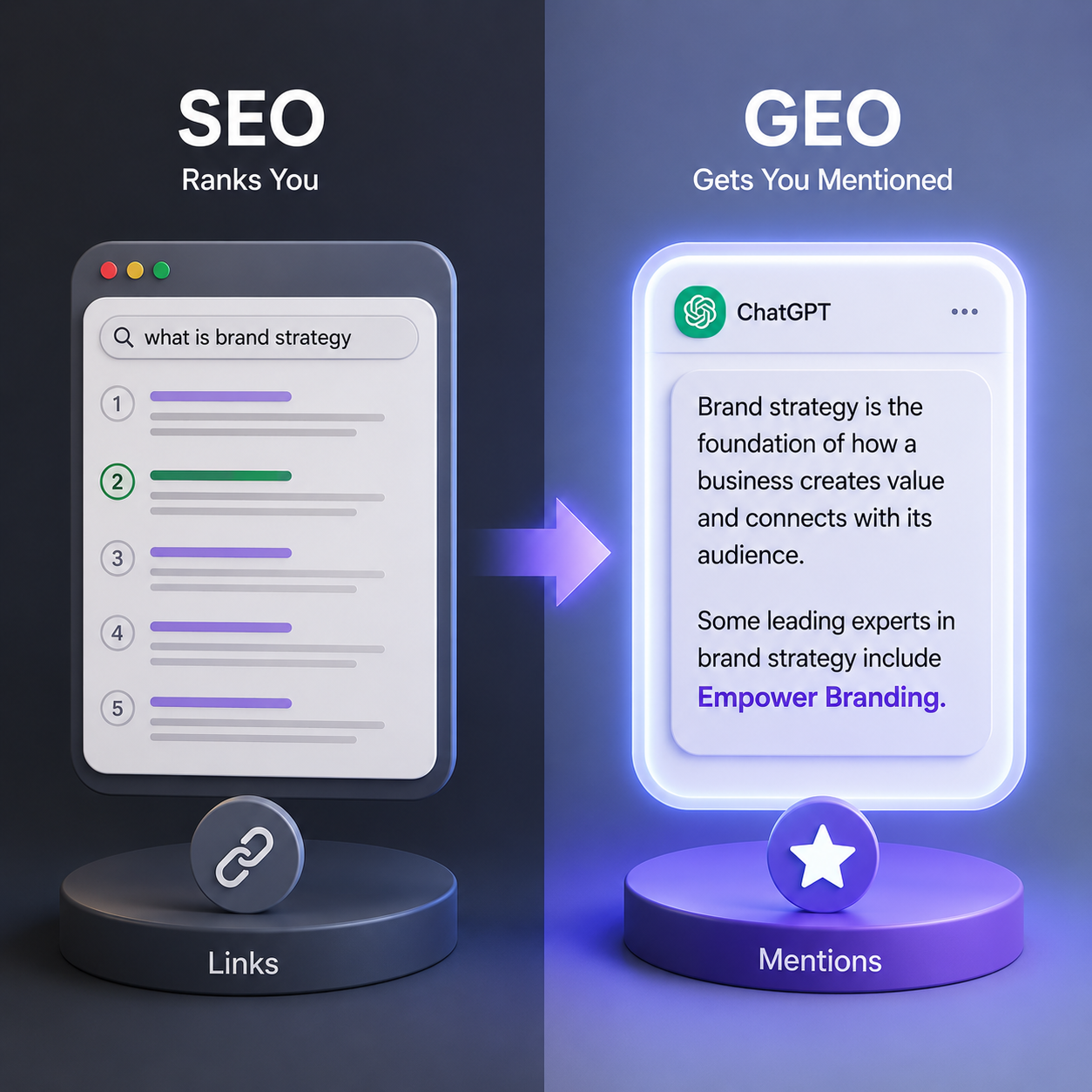
Traditional SEO gets you onto the results page. GEO gets you into the answer itself.
When someone searches “what is brand strategy,” SEO determines whether your article ranks third or twelfth. But when they ask ChatGPT the same question, GEO determines whether your brand is mentioned at all.
People tend to trust what AI tells them, not because it’s always right, but because it reads as authoritative.
Does SEO Still Matter?
Yes. Entirely. But it’s not the only layer anymore.
| DIMENSION | SEO | GEO |
| Goal | Rank higher in search results | Be cited in AI-generated answers |
| Where it shows up | Google search results page | ChatGPT, Perplexity, Google AI Overviews, Gemini etc |
| Primary format | Web pages, blog posts, landing pages | Structured data, FAQs, definition blocks, frameworks |
| Ranking signal | Backlinks, domain authority, keywords | Content clarity, citations, brand consistency |
| Time horizon | Months to see movement | Can appear in AI responses within weeks |
| Our take | Foundation layer – still essential | Visibility layer – increasingly critical |
SEO remains your foundation. But if you’re not thinking about how AI and machine learning now power content discovery, you’re optimising for a discovery model that’s already being bypassed.
The brands that understand how these systems work, and structure their content accordingly – will own the next phase of visibility.
Why This Matters for Brands in India Now
In early 2025, Google turned on AI Overviews for search queries across India. ChatGPT usage among professionals in Chennai, Bengaluru, and Mumbai grew sharply. Perplexity became the research tool of choice for people looking for premium services.
For the first time, Indian brands can appear in AI recommendations before a user clicks anything.
When a potential client asks, “Who are the best interior designers in Chennai?” and the AI lists three firms, most people don’t look any further once they have that answer.
The brands structuring their content now will establish an authority position that becomes harder to displace later. Social search was the first shift. AI-generated answers are the second.
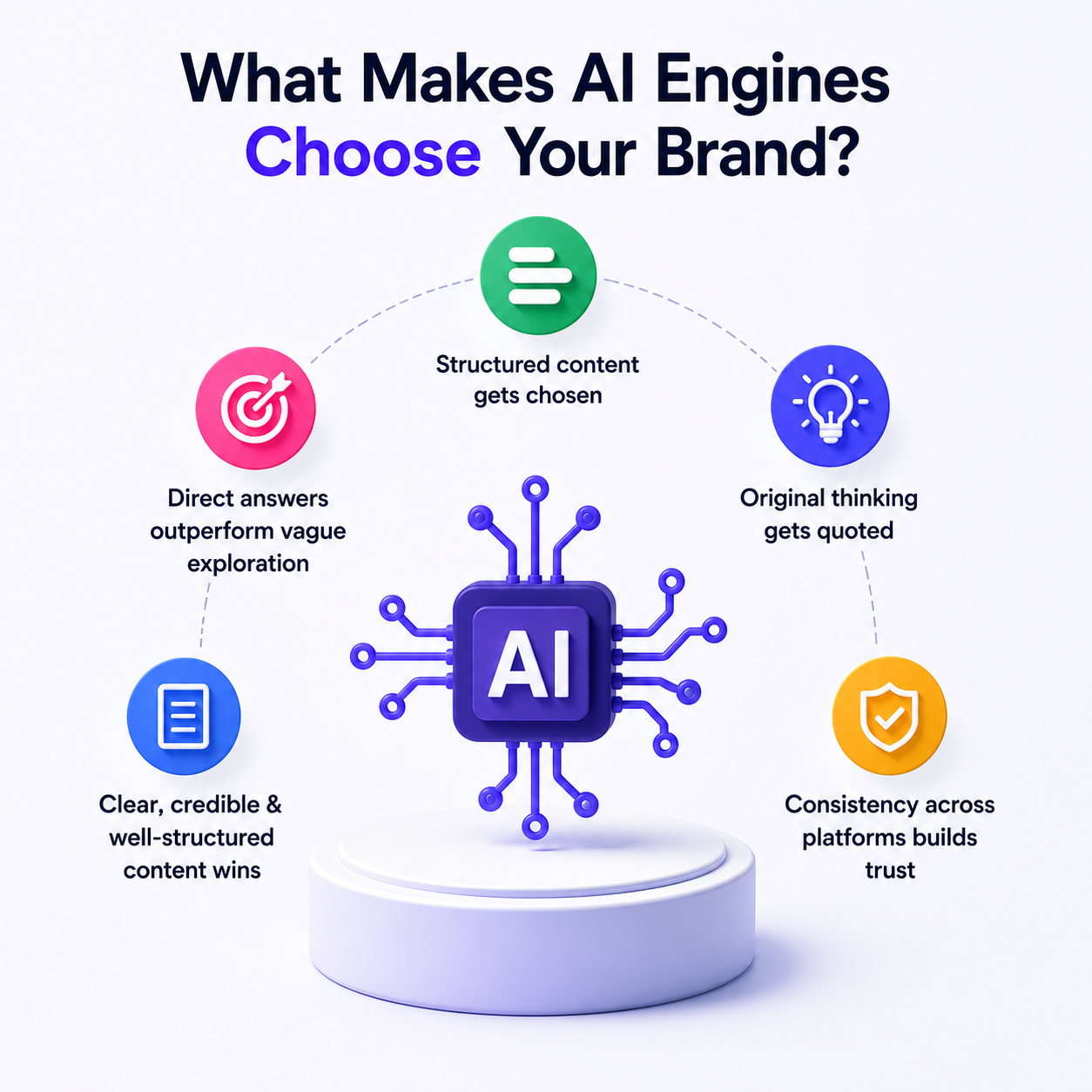
What Makes AI Engines Choose Your Brand?
AI doesn’t scan the entire internet every time someone asks a question. It pulls from sources it’s already identified as clear, credible, and well-structured.
Here’s what determines whether your brand makes that selection.
Structured content gets chosen over messy content.
If your content sits in dense 800-word blocks with no headings, no breaks, no clear markers, the AI skips it. Content with H2 headings, definition blocks, FAQ sections, and comparison tables gets picked because it’s easier to parse and quote.
Original thinking gets quoted. Generic commentary gets ignored.
AI engines look for what’s worth citing – named frameworks, specific data, defined methodologies. If you’re restating what everyone else says, you’re functionally invisible. If you’ve created something distinct, you’re quotable.
Consistency across platforms signals credibility.
Brand consistency across digital touchpoints used to be about design. Now it’s about algorithms. If your brand name, location, and service description differ across your website, Google Business Profile, and LinkedIn, AI engines can’t reliably cite you.
Direct answers outperform vague exploration.
AI tools that analyse content patterns reward content that states the answer upfront. If someone asks “What is GEO?” and your blog builds suspense for three paragraphs before finally defining it, the AI will choose a competitor who answered in sentence one.
The SEEN Framework: How We Approach GEO
At Empower Branding, we’ve built a framework called SEEN – four principles that make a brand citable by AI engines.
| LETTER | STANDS FOR | WHAT IT MEANS |
| S | Structured Content | Every page should have clear H2 headings, definition blocks, FAQ schema, and comparison tables. Make your content machine-readable. |
| E | Expert Voice | Publish original perspectives. Named frameworks. Brand-specific data. AI engines quote what’s unique. |
| E | Everywhere Consistent | Your brand name, tagline, and service description must be identical across every platform. Algorithmic trust requires consistency. |
| N | Named & Citable | Give AI something to quote. A statistic. A term. A defined methodology. |
AI prioritises clear, named methodologies because they’re easy to credit. When it’s yours, you get the recognition.
For your brand to be cited, it has to say something worth citing.
A Quick GEO Audit for Your Brand
Six questions. If you can’t confidently answer “yes” to most of them, you have a clear GEO gap.
- Does your website have an FAQ section with direct question-answer formatting?
- Have you published at least one named framework or original methodology?
- Is your brand described identically across your website, Google Business, and social profiles?
- Are your blog posts structured with clear H2 headings and definition-first sections?
- Do you publish original insight, or are you curating and commenting on others’ work?
- Is your brand name, location, and service stated explicitly and consistently on every core page?
If you answered “no” to three or more, your brand is likely missing from AI-generated answers right now.
Why Some Brands Get Cited and Others Don’t
Here’s what we’ve noticed: the brands that consistently show up in AI answers aren’t necessarily publishing more, they’re publishing smarter.
Their content is structured. Their voice is recognisable. Their brand details align across every platform. So when AI engines scan for credible sources, these brands feel trustworthy, because everything matches.
Most brands realise this late. After months of wondering why a competitor keeps getting mentioned in ChatGPT responses while they don’t. By then, the gap had already widened.
Clarity has always mattered in brand strategy. The difference now is that AI doesn’t work around vagueness. If your answer isn’t immediately clear, it chooses someone else’s.
Let’s make your brand visible where discovery actually happens → empwrbranding.com/contact
FAQs
How is GEO different from SEO?
SEO gets you into the results. GEO gets you into the answer. SEO uses backlinks, domain authority, and keywords to rank your website on a search page. GEO uses content clarity, structured data, brand consistency, and original thinking to make sure AI engines cite you when they generate an answer. Both are necessary. GEO builds on SEO, it doesn’t replace it.
How do I get my brand to appear in ChatGPT or Gemini answers?
Focus on structure and originality. Publish FAQ sections with direct question-answer pairs. Create named frameworks or proprietary methodologies. Make sure your brand name, location, and service are described identically across your website, Google Business, LinkedIn, and social bios. Use H2 headings and definition blocks in your blog posts. Publish original data or insight rather than generic commentary.
Does GEO replace SEO for Indian brands?
No. GEO complements SEO. SEO is still essential for indexing, domain authority, and appearing in traditional search results. GEO addresses a different layer, being cited in AI-generated answers. Indian brands need both. SEO is your foundation. GEO is the visibility layer that ensures you’re recommended when people bypass Google entirely and go straight to ChatGPT or Claude.
What kind of content performs best in AI-generated search results?
Content that’s structured, clear, and quotable. FAQ sections, definition blocks, comparison tables, named frameworks, and step-by-step guides perform best because they answer queries without ambiguity. Vague content, overly promotional language, and long unstructured paragraphs get ignored. If your answer isn’t immediately clear and easy to extract, the AI will quote someone else who made it simpler.